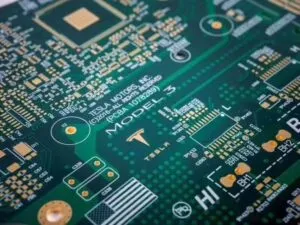
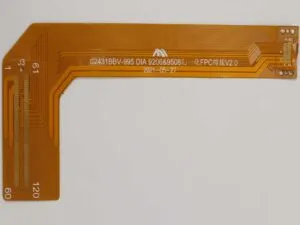
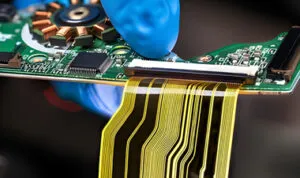
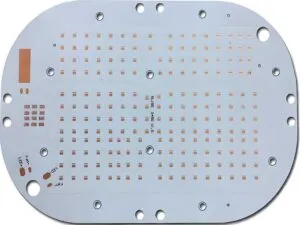
Rogers PCB refers to high-frequency circuit boards manufactured using specialized laminates produced by Rogers Corporation (USA). Unlike traditional FR-4 PCBs (epoxy resin/glass fiber), Rogers PCBs use ceramic-filled polymers or PTFE (Teflon)-based materials, optimized for high-speed, high-frequency applications where signal integrity and thermal stability are critical.
Key Characteristics of Rogers PCB
Superior Electrical Performance
Low Dielectric Loss (Df): Typically 0.001–0.004 (vs. FR-4’s 0.02), minimizing signal distortion in high-frequency transmissions.
Stable Dielectric Constant (Dk): Ranges from 2.2 to 16 (adjustable by material series), ensuring consistent impedance control across frequencies.
Low Signal Loss: Critical for 5G, radar (77 GHz), and satellite communications.
Thermal & Environmental Resilience
High Thermal Conductivity (0.5–2 W/mK): Dissipates heat efficiently, supporting high-power applications like amplifiers.
Low Moisture Absorption (0.02–0.08%): Maintains performance in humid environments, unlike FR-4 (0.1–0.2%).
High Glass Transition Temperature (Tg): Exceeds 280°C, with decomposition temperatures up to 390°C, suitable for aerospace and automotive electronics.
Mechanical Stability
Low CTE (Coefficient of Thermal Expansion): Matches copper’s expansion rate (10–17 ppm/°C), preventing delamination or via cracks.
Dimensional Rigidity: Minimal warping under thermal stress.
Comparison with FR-4 PCBs
| Property | Rogers PCB | FR-4 PCB |
|---|---|---|
| Frequency Range | >500 MHz (up to 110 GHz) | <500 MHz |
| Dielectric Loss | 0.001–0.004 | ~0.020 |
| Thermal Conductivity | 0.5–2 W/mK | ~0.3 W/mK |
| Cost | High (material-driven) | Low |
| Applications | 5G, Aerospace, Radar | Consumer electronics, Low-frequency circuits |
| Data derived from comparative studies in search results |
Common Rogers Material Series
RO3000 Series (PTFE + Ceramic): e.g., RO3003 (Dk=3.0), used in radar and 10+ GHz RF circuits.
RO4000 Series (Hydrocarbon + Ceramic): e.g., RO4350B (Dk=3.48), balances cost and performance for antenna designs.
RT/duroid Series (PTFE Composites): e.g., RT/duroid 5880 (Dk=2.2), ideal for millimeter-wave applications.
TMM Series: High thermal management for extreme environments (e.g., TMM10i).

Rogers PCB Manufacturing Nuances
Requires precision processes: Laser drilling, controlled impedance routing, and specialized surface finishes (e.g., immersion gold).
Compatible with FR-4 in hybrid designs (e.g., Rogers for RF layers, FR-4 for support layers) to reduce costs.
Applications
Telecom: 5G base stations, microwave antennas.
Aerospace/Defense: Radar systems, satellite communications (low outgassing critical for vacuum environments).
Automotive: ADAS sensors, 77-GHz radar.
Medical: MRI machines, implantable devices.
Future Trends
Material Innovation: Enhanced thermal/mechanical properties for 6G and quantum computing.
Cost Optimization: Hybrid designs and new series (e.g., RO4830 for automotive radar) bridging performance and affordability.
Conclusion
Rogers PCBs excel in high-frequency, high-reliability scenarios where FR-4 falls short. While costlier, their electrical stability, thermal resilience, and low loss justify use in mission-critical systems. For cost-sensitive projects, hybrid designs (Rogers + FR-4) offer a practical compromise
Rogers PCB board, High frequency circuit board
High-frequency PCB is supplied and manufactured from PCBA123, with competitive price and durable quality. This high-frequency PCB can meet faster signal flow rates when a special signal requirement into electronic components and products. This high transmission frequency could provide a faster signal flow rate which is necessary for electronic devices with high frequency like wireless networks, satellite communication. Email us by sales@pcba123.com, you can get a free quick quote on custom Rogers PCB.